 Mitgliederbereich
BL13-News 07/26
Information by the University Union
The Federal Executive Committee 13 (BL13) is the representative body for academic and artistic university staff within the Public Service Union (GÖD). We are pleased to provide you with this information as a member of the GÖD.
With a newly elected committee and an ambitious programme of work, the University Union will campaign for better working conditions, fair pay, equality and reliable career paths at Austria’s universities in the coming years. Find out how the union is tackling impending budget cuts and contributing to the development of the Higher Education Strategy 2040, as well as the planned reform of §109 of the University Act, which permits fixed-term employment contracts. We are also providing information about an AK event on part-time work, workload and work-life balance.
Important decisions regarding university budgets, career paths and labour law will be made in the coming months—we’ll keep you up to date on developments, negotiations and opportunities to have a say.
We look forward to your feedback via e-mail to redaktion.bl13@goed.at!
Members of the new Federal Executive Committee
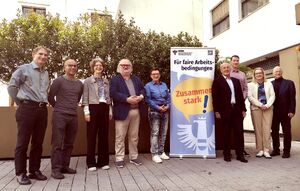
At the Federal Congress of Federal Representation (Bundesvertretung 13) on 7 and 8 May 2026, the members of the Federal Executive Committee (BL) and the Expanded Federal Executive Committee (eBL) were elected for the next five years.
BL13 is the University Union's working committee. It also represents the interests of our professional group within the GÖD. BL13 members address issues related to labour and university law, and are involved in collective bargaining negotiations, albeit only in an advisory capacity to the GÖD’s chief negotiators. Martin Tiefenthaler (MUI) was elected as the BL13 chair and Sabine Hammer (VMU) as the vice chair. The other members of the Federal Executive Committee are: Christian Dank (University of Vienna), Manfred Gabriel (University of Salzburg), Ulrike Hugl (University of Innsbruck), Florian Part (BOKU), Angela Wegscheider (JKU Linz), Christian Wessely (University of Graz), Helmut Woschitz (Graz University of Technology) See our BV13 website: Team.
The eBL has 28 members and thus covers the broad Austrian university landscape. Within this group, issues related to labour and university law are addressed. See: Die erweiterte BL13.
At the Federal Congress, the members adopted the prepared motions. The eleven motions — some of which are very comprehensive — address topics intended to improve working conditions at universities. They will now be presented at the GÖD Federal Congress (17–19 November 2026). The adopted motions will then form the BV13's work programme for the next five years. The motions address improvements in the areas of labour law, salary increases, equality, diversity of career paths, work-life balance and numerous improvements to the university collective bargaining agreement.
Demonstrations against austerity measures in May
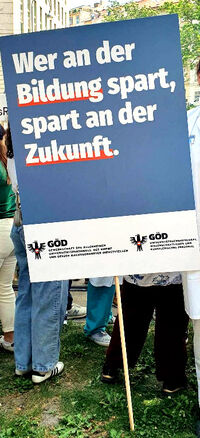
The university union remains deeply concerned about the announced massive austerity measures at universities. At the end of May, 28,000 people demonstrated in Vienna against the planned budget cuts, with thousands more participating in large demonstrations in Klagenfurt, Graz, Salzburg and Linz. The demonstrations were supported by the union, the works councils and the university administrations, as well as being widely backed by students.
Please note that employees at Austrian universities have already contributed significantly to financing the “Pact for Research, Technology, and Innovation” (FTI) through modest wage increases in 2026 and 2027. For this reason, the social partners negotiated a two-year wage adjustment in December 2025. University employees have already helped the government by accepting a real wage cut! The social partners assumed that they had thereby contributed sufficiently to budget consolidation. Now, however, the universities are being asked to pay twice over.
The demonstrations have led to the planned austerity measures being renegotiated. Further negotiations on this will take place in autumn as part of the performance agreement talks between the universities and the Federal Ministry. Depending on the outcome of these discussions, there may be further large-scale protests this autumn.
Higher Education Strategy 2040 – we try hard to have a say

Earlier this year, the Ministry of Science began developing the Higher Education Strategy 2040. The ministry aims to reform the science sector in collaboration with stakeholders. Several eBL members are involved, contributing their professional expertise and union perspectives.
Among other things, the strategy addresses issues such as working conditions and democratisation. See: Hochschulstrategie 2040 - Bundesministerium für Frauen, Wissenschaft und Forschung. On 22 June, Minister Eva-Maria Holzleitner announced her “progressive strategic course-setting for the universities of tomorrow”. The federal minister’s announcements are available online as a press release: Progressive strategische Weichenstellungen für die Hochschulen von morgen - Bundesministerium für Frauen, Wissenschaft und Forschung. The ministry intends to repeal §109 of the University Act (UG) and facilitate reliable career paths (see next post).
The minister also raised the issue of democratising universities and introducing a faculty model. However, she did not specify exactly what she meant by this. Alongside the Anglo-American model, we are also familiar with the Scandinavian model. Both feature earlier career decisions (e.g. tenured faculty positions) and diversified career paths (e.g. Reader, Lecturer, Assistant and Associate Professorships), as well as flat hierarchies. Some universities also have their own unique structures. What they all have in common is that the budget, consisting of global and third-party funding, is allocated collectively, meaning no single individual can play a central role.
The Anglo-American model, and especially the version established in the United Kingdom, features very strict performance criteria and evaluations that can lead to termination if targets are not met or student enrolment declines (as these universities are largely funded by tuition fees). In contrast, the Scandinavian model features less hierarchy, more collaboration and less dependence.
The Scandinavian model is also well-suited to reducing hierarchies, moving away from the chair model and promoting greater cooperation. As the most important financial stakeholder, the federal government could influence the distribution of funds (e.g. by requiring university administrations to allocate funds to organisational units, departments or faculties rather than to individuals as chair endowments).
It remains to be seen what specific measures will be included in the Federal Ministry’s strategy paper. Drafts are expected to be submitted by early next year. In the meantime, information events on this topic are planned for November 2026 at numerous higher education institutions.
To stay up to date with the latest developments, we recommend signing up for the Newsletter Anmeldung - Hochschulstrategie 2040 or following the BMBF’s social media channels: Facebook — Instagram — LinkedIn.
Planned reform of §109 of the University Act (UG) – quo vadis?

The Minister of Science, Eva-Maria Holzleitner, has announced her intention to restrict fixed-term contracts at universities in the media. The union has long demanded limits on the use of fixed-term contracts, so BV13 welcomes this initiative.
Currently, universities are exempt from general Austrian labour law through §109 of the University Act of 2002 (UG 2002). General Austrian labour law typically permits only one fixed-term contract, but §109 of the UG 2002 allows universities to hire employees on fixed-term contracts more frequently without providing specific justification. The legislature intended §109 to be a provision for special cases, but it is predominantly applied as the norm.
Angelika Schmidt from the Vienna University of Economics and Business (WU Wien; member of eBL13) and Angela Wegscheider from the Johannes Kepler University Linz (JKU Linz; member of BL13) have outlined the problems this causes for organisations and individuals in a recently published blog post. At www.awblog.at/Bildung/Weichen-stellen-fuer-Hochschulen-von-morgen/, they summarise the situation and outline ideas for an improved, forward-looking personnel policy.
The Ministry has now also acknowledged that a change is necessary. Various press reports have indicated that the minister is considering repealing §109 of the University Act (UG). Whatever the solution to this real-world problem may be, one thing is clear: if this exemption were repealed, standard labour law would apply to employment contracts at universities. Successive fixed-term employment contracts (also known as “chain contracts”) without objective justification would then be permitted only to a limited extent. However, it must be taken into account that the situation of university academic and artistic staff, who are generally highly specialised in niche fields, is only partially compatible with the conditions of the “open labour market”. To ensure that the change does not create other serious problems, the GÖD is in constant communication with the ministry. The ministry is very receptive to the GÖD’s proposals. If you have any suggestions or ideas regarding the planned reform, please send them to us!
Join the discussion at the event “Work Between Expectations and Contracts: A Focus on Part-Time Work at Universities' (AK Vienna)

For many, working at a university is a dream come true, yet it also has its downsides. It is precisely this great enthusiasm for the profession that often leads to self-exploitation, with competition putting many researchers and instructors under pressure to accept unfair working conditions. Excessive hours, overwork and involuntary part-time work are all part of everyday life, as is the challenge of balancing academia and family life. As part of this discussion event, the Vienna Chamber of Labour (AK Wien) will address the following questions: Where are the biggest areas for improvement? What does a healthy and fair work schedule look like for part-time employees at universities? These and other questions will be discussed.
Time: Tuesday, 22 September 2026, 18:00
Location: FAKTory, Universitätsstraße 9, 1010 Vienna
Online via livestream
Following opening remarks by Angelika Schmidt (WU, AK Wien Councillor) and Sabine Hammer (VMU, GÖD BL 13), there will be a panel discussion featuring:
- Christian de Vito, University of Vienna, Workload and Quality of Work Initiative
- Cornelia Dlabaja, University of Vienna, NuWiss
- Claudine-Caroline Egger, BOKU, Motherhood and Science Network
- Maximilian Ender, BOKU, pre-doctoral researcher
- Moderator: Hannah Czernohorszky, Vienna Chamber of Labour
Registration: https://veranstaltung.akwien.at/de/arbeiten-zwischen-anspruch-und-vertrag-teilzeit-an-universitaeten-im-fokus (Please select your preferred participation mode when registering for the livestream).