 Mitgliederbereich
BL13-News 06/25
Information by the University Union
The conditions for trade union work in the second half of the year were dominated by the successful conclusion of intensive negotiations on changes to the framework legislation in the collective agreement. At the same time, the ongoing precarious situation of the federal budget also had an impact on the university sector, leading to a very sobering phase in the valorisation negotiations.
In this issue, we provide detailed information on the results of these negotiations and present the changes achieved in the framework legislation. We provide an insight into the interaction between the works councils, the Chamber of Labour and the trade union, present further training opportunities, give an outlook on the dialogue on the development of the Higher Education Strategy 2040, which is just getting underway, and present excerpts from a position paper on the challenges to academic freedom.
An intense year 2025 is coming to an end. The BL13 editorial team wishes everyone a good end to the year and a Merry Christmas. We welcome topic suggestions and further feedback. Simply send an email to redaktion.bl13@goed.at!
Collective agreement
Valorisation negotiations concluded

On 13 November and 1 December, the annual negotiations with the umbrella organisation on the revaluation of collective agreement salaries took place. The following demands were submitted by the GÖD to the umbrella organisation:
- Salary increase in line with inflation: 3% for 2026 and 2% for 2027
- Salary agreement effective from 1 January 2026
- Further improvement of the B1 scheme
- Recognition of equivalent post-doctoral service periods
- Overtime pay for part-time employees for additional work
The negotiating partners' positions were far apart. The starting point was extremely unfavourable for the GÖD's demands: in many sectors, wage agreements reached in the autumn were very moderate and below the inflation rate. In addition, it became known in November that the Federal Ministry for Women, Science and Research (BMFWF) still had a funding gap of approximately EUR 150 million for the Research, Technology and Innovation (FTI) Pact – details can be found in the following article. This signalled a ‘play off’ between the differently financed areas of non-university-funded third-party research and universities.
The prospects for an acceptable agreement were therefore bleak, even though the pressure exerted by rising inflation on the income situation of precarious temporary and part-time employees had already reached the staff representatives. There were loud calls for agreements that would not exacerbate the tangible effects of inflation, with a 2.55% increase cited as the most reasonable minimum. There were also suggestions to continue negotiations on the countless open issues in the framework legislation, such as extensions to the calculation of previous periods of service, extension circumstances, sabbatical regulations, regulations regarding location-independent working and overtime regulations.
On the employer side, threats were then made in the negotiations with regard to inflationary pressures and the resulting staff cuts. We also rejected comparisons with other sectors (e.g. the metalworking industry or trade) due to the specific financing and service provision situation.
The outcome of the negotiations is very far removed from these ideas and wishes:
- There is a 2-year agreement
- 2026 + 1.65 per cent, but at least €60
- 2027 + 1.3 per cent, but at least €60
- No further assurances for the continuation of framework negotiations
The bottom line is that real wages will fall – there's no sugar-coating it! This also became clear at the virtual, nationwide works meeting on 5 December 2025, where Martin Tiefenthaler, chair of Federal Executive Committee 13, presented the outcome of the negotiations. Many of the more than 500 colleagues who were present at times also expressed their disappointment and incomprehension about the result in comments and questions.
This year's revaluation results are disappointing. Against this backdrop, it may seem counterproductive at first glance to encourage people in your circle to join a trade union. However, on closer inspection and with a view to upcoming negotiations, a visible increase in membership could significantly strengthen the negotiating power of the bargaining parties. The union is a fighting organisation. It can fight if it has enough members. Among university staff, union membership is in the single digits. So if you have colleagues in your circle who are interested in politics, encourage them to join. Change the union from within the union!
Collective agreement - Framework legislation
An improvement to the B1 pay scale has been achieved!

With effect from 1 January 2025, the last salary level in lit. d of the B 1 pay scale (see Uni-KV § 49 (3)) has been increased by half (250 euros) and a new salary level has been introduced in lit. e. See also § 81 (25) Uni-KV. The B1 scheme is used to remunerate university assistants, senior scientists, senior artists, senior lecturers and project staff.
Only professors, associate professors and lecturers have different salary scales. A specially formulated side letter ensures that further improvements to this salary scale will be negotiated in the course of 2025 (now postponed to 2026). For the union, this result is a first partial success.
The big hurdle in the B scheme still lies ahead: raising the starting salary, shortening the promotion period from eight to six years, and introducing additional salary levels at the end of the period of service. We will bring these demands to the table in every further negotiation and fight for them.
Collective agreement - Framework legislation
Declaration of intent to make more third-party funding positions permanent in future

One of the union's key objectives is to improve the career prospects of all academic and artistic staff. We are also committed to ensuring that more permanent positions are created for staff financed by global and third-party funds. The university must not place obstacles in the way of those who finance themselves with the help of third-party funding. They should finally be given permanent contracts instead of being hindered in their research.
Against this backdrop, there were lengthy negotiations with the umbrella organisation. The rectors emphasised that the universities want to give more third-party-funded staff permanent contracts. However, their condition is that they can terminate permanent project staff at the end of the month even after five years. Until now, this was only possible at the end of the quarter.
The GÖD, together with the umbrella organisation, has drafted Section 21 (2a), which increases the termination options for permanent project staff from 4 to 12, and a joint declaration in Section 81, which aims to establish the conditions for the application and increase of permanent contracts in the area of third-party funding. The aim of these measures is to promote more permanent contracts.
Section 21 (2a) only applies if the discontinuation or reduction of third-party project funding prevents employment at the relevant organisational unit from being more than temporary. However, if the person has submitted an application for third-party funding, the university will cover the costs for a transitional period of up to 12 months until new or continued funding from third-party sources is secured for the relevant organisational unit. The application process must not be hindered. The validity of Section 21 (2a) is limited in time and initially applies for the period from 1 January 2026 to 31 December 2029. We will monitor developments closely!
If developments and evaluations are positive, i.e. if there is an increase in the number of permanent positions for women and men employed with third-party funding, and if university management supports applications for funding for self-employment to work on a scientific project beyond the maximum limit for fixed-term contracts, both sides will seek an extension.
In order to better understand these developments, we need your feedback. Please let us know directly or via your works council colleagues how the situation is developing in your areas. These developments are a very important source of information for us!
Works councils – Chamber of Labour – Trade unions
Who does what?
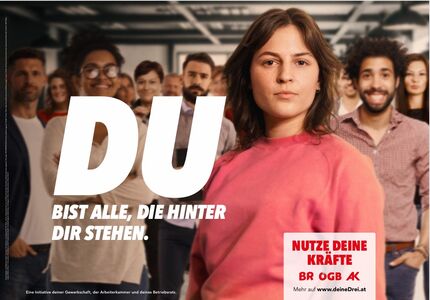
The interests of employees are represented in close cooperation between three key organisations, which are closely networked but operate at different levels.
At local level, these are the works councils, whose members have just been newly elected in many places. At a broader level, all colleagues employed under collective agreements are represented by the Chamber of Labour. This compulsory membership has a long tradition in Austria and is repeatedly questioned, particularly by employers. The role of trade unions is also a recurring topic of discussion. This article takes a closer look at what lies behind these three representative bodies.
Pillar 1: Works councils – at company level
- represent your interests in the company vis-à-vis management/senior management,
- support and advise you in case of uncertainties regarding your employment contract or a wide range of other questions arising from the working relationship,
- conclude works agreements,
- prepare demands for collective agreement adjustments in line with the needs of the workforce and forward these to the relevant industry representatives in the trade union,
- monitor compliance with labour law and
- mobilise for industrial action such as works meetings, demonstrations or strikes.
General information on this can be found at: https://www.betriebsraete.at
The concerns of local works council groups have always been to create fair working conditions and to negotiate specific regulations through active participation in, for example, works agreements. Find out about the specific activities of your works council on your institution's website.
Pillar 2: The Chamber of Labour
- represents your interests vis-à-vis the state and politicians and provides impetus for public debate – such as the re-democratisation of 2025,
- supports you with labour law issues,
- advises you on labour law and consumer protection,
- analyses and researches key data for wage and salary negotiations.
General information on this can be found at: https://www.arbeiterkammer.at.
The establishment of the Chamber of Labour was a key milestone in the institutional consolidation of social partnership. After decades of efforts by the trade union movement, the Act on the Establishment of Chambers for Workers and Employees was passed in February 1920. The Chambers of Labour are intended to be equal partners to the Chambers of Commerce.
In over 100 years of existence, the Chamber of Labour has established a central role in providing independent legal advice in the field of labour law, but increasingly also in consumer protection. If you have individual labour law problems, you can arrange for on-site consultations – important when pre-registering: indicate that you work at a university, because then care will be taken when assigning the consultation partner to ensure that the advisor has experience in this area.
The Chamber of Labour (AK) represents the interests of almost 4 million working people in Austria. Its focus is on workers' rights. The AK has campaigned to ensure that workers are heard, paid fairly and have legal protection.
Each federal state has an AK plenary assembly, which is elected by its members every five years. The Vienna plenary assembly has 180 chamber councillors who come from many different industries and represent the interests of people in these sectors.
Since university employees have only been employees falling within the AK's sphere of influence since the spin-off, there have been very few representatives from our sector for a very long time. Since this year, there are finally two (!) representatives from the university sector who bring concrete working conditions at universities to the plenary assembly and the various specialist committees – an absolutely important task.
A first focus in this term of office was democracy and co-determination: the motto of the consultations in May was ‘Democracy: it is not a given – and it is under pressure everywhere!’ Once again, there were calls for Austrian universal suffrage to be modelled on the AK's electoral regulations. Since the founding and implementation of the first AK election in 1921, all AK members have been able to vote, regardless of their citizenship. This is still the case today.
At the last plenary meeting in November, the focus was on ‘Counting women in’. Käthe Leichter founded the Women's Department of the AK Vienna 100 years ago. What Käthe Leichter began as a pioneer in 1925 as the first head of the Women's Department is now an indispensable part of the fight for justice. Women still earn significantly less than men today – this is also shown by analyses of income reports in our field. Käthe Leichter's demands are still relevant today, and there are currently very intense discussions about the implementation of the NEW wage transparency law – and these discussions will also benefit us at universities.
Pillar 3: Trade unions – sectoral level
- represent your interests in your industry,
- advise you on legal issues and support you in court
- negotiate collective agreements in consultation with and based on proposals from industry/professional associations – in our case, Federal Executive Committees 13 (scientific and artistic staff) and 16 (general administrative staff)
- organise industrial action such as works meetings, demonstrations or strikes.
General information on this can be found at: Österreichischer Gewerkschaftsbund | ÖGB; Gewerkschaft Öffentlicher Dienst, GÖD
With the outsourcing of universities, the accompanying University Act (UG 2002) laid the foundation for a collective agreement to be concluded between the relevant trade union – the Public Service Union (GÖD) – and the umbrella organisation of universities on key labour law issues.
This collective agreement has been in place since 2009, and there are two professional associations within the GÖD – Federal Executive Committee 13 for the work of scientists and artists at Austrian universities and Federal Executive Committee 16 for general university staff – which advise the GÖD's chief negotiators on the further development of the collective agreement.
During these consultations, these professional associations seek dialogue with local works councils – this was again the case this year in the run-up to the valorisation negotiations. A separate article in this newsletter will discuss this year's results in more detail.
Trade unions are, in their basic structure, campaigning organisations – they strengthen their representatives at the negotiating table through a wide variety of measures. They can fight if they have enough members. Among university staff, union membership is in the single digits. Looking at the agreements reached in recent years, one might rightly ask why it makes sense to support this form of representation. At the same time, however, the negotiating partners repeatedly point to the low level of union membership – a vicious circle that we would very much like to break.
If you would like to discuss the work of the Chamber of Labour in more detail or have suggestions and ideas for breaking the vicious circle of trade union work described above, we would be delighted to receive your feedback and are happy to engage in dialogue.
Training opportunities for new works council members
Short and long form

Works council elections were held at many universities in November, and new members are joining many works council committees.
Dealing with staff representation issues for the first time is a great and exciting job, but it also comes with a number of challenges. The practical work of the works council and advising colleagues is an exciting activity that grows with experience. In addition, works council work is accompanied by an intertwining of operational and political work, and these connections are not always entirely self-explanatory and transparent.
If you would like to receive structured information on this topic, the following training opportunities are ideal for you:
Short version – 2.5 days – Introduction to works council work
The Federal Executive Committee 13 is organising a short seminar in which two experienced colleagues from the legal department of the GÖD (Mag. Jasmin Benesch) and the social policy department of the AK Vienna (Mag. Julia Vazny-König) will explain the key cornerstones for the interaction between the various institutions and, above all, legal areas.
- Period: Wednesday, 18 February 2026, afternoon, to Friday, 20 February 2026, noon
- Location: Hotel Alpenblick (Startseite - Hotel Alpenblick), Kirchschlag/Linz
Please register for this short seminar by 5 February 2026 at the latest at office.bv13symbolgoedpunktat.
Long format – 14 weeks – intensive course
Every year, the Works Council Academy (BRAK) offers a 14-week intensive course on trade union policy, aimed at active works council members from companies in Vienna.
- Online information session: 29 January 2026, 10:00 a.m. – 12:00 p.m.
- The BRAK begins on 7 September 2026 and ends on 11 December 2026.
Nominations are made by the relevant trade union – in this case, the GÖD. The nomination period ends on 23 January 2026. The AK Wien executive committee will make the final decision on participation.
These training periods – both short and long – count as working time in terms of extended educational leave. The editorial team is happy to answer any questions you may have about the two training options.
Start of the dialogue on the Higher Education Strategy 2040

As a trade union representative, it is a key concern of ours to achieve solutions and improvements for the work of scientists and artists at Austrian universities in accordance with the 2002 University Act. Accordingly, we have also been involved in updating the Austrian University Development Plan 2028-2033.
We consider the sections on careers, internationalisation, equality/diversity and the social dimension to be particularly important areas, which are also repeatedly reflected in our work with local staff representatives at individual university locations, and we submitted a corresponding statement on this in September.
The GUEP forms the basis for the dialogue ‘Shaping the Future: Higher Education Strategy 2040’, which was launched at the beginning of December 2025. The aim of this dialogue is to develop a new strategy paper for the further development of the scientific field and the higher education sector through in-depth discussions in various working groups over the course of the coming year.
At the kick-off event, which was attended by more than 250 participants, the following topics were identified as key areas:
- Higher education and democracy. Shaping the democracy-strengthening universities of the future.
- Cooperative and collaborative. Shaping the future of cross-university cooperation.
- Joyful and active. Shaping the framework conditions for the studies of the future.
- Open and socially just. Enabling a diverse and inclusive future at Austria's universities.
- Attractive and promising. Shaping the future for scientists and their career paths.
- International and visible. Strengthening the future of Austrian higher education in the international arena.
- Innovative and excellent. Developing solutions for the future today.
- High-quality and efficient. Shaping the future of higher education organisation.
The development of these issues will have medium- and long-term effects on working conditions in our sector. If you participate in this dialogue, we would appreciate your feedback so that we can work with you to refine the union's positions on individual areas.
Please contact the editorial team or Angelika.Schmidtsymbolmy.goedpunktat directly.
University talks
Challenges to academic freedom at Austrian universities from the perspective of the trade union
Freedom of teaching was first enshrined in the Paulskirchen Constitution of 1848: Science and its teaching are free. As is well known, the Paulskirchen Constitution had a very short direct effect. In Austria, this was laid down in the 1867 Constitution and incorporated into the Constitution of the Second Republic, where it remains in force to this day. The BDG and the collective agreement also excluded (divergent) teaching opinions as grounds for dismissal (Uni-KV §22 (7)). However, the framework conditions have changed.
Twenty years after the University Act 2002 came into force, the majority of academic and artistic staff at universities, i.e. more than 80%, are employed on a temporary basis, often part-time and therefore dependent. Temporary employment offers only limited freedom in research. Especially when it comes to independent applications, success and security are more important than inclinations and interests.
Successful third-party funding acquisition is geared towards mainstream research. Niche research or interdisciplinary research is often not eligible for funding. And even if excellent projects are submitted, interdisciplinary projects are often not given sufficient priority to receive funding. In summary, it can be said that excellent researchers are successful in submitting their own applications in the mainstream, but that this restricts the freedom of research.
Science award winners such as Ralf Steinmann (discoverer of the dendritic cell, Nobel Prize in Physiology together with Bruce Beutler and Jules Hoffmann in 2011), Avram Herschko (work on the proteasome, 2004 Nobel Prize in Chemistry together with Aaron Ciechanover and Irwin Rose) and, last but not least, Anton Zeilinger (2022 Nobel Prize in Physics for quantum teleportation together with Alain Aspect and John Clauser) have stated personally or – as in Zeilinger's case, repeatedly in public – that their groundbreaking or initial and later award-winning research would not have been funded under the current system.
If, as planned, successful third-party funded staff are then transferred to global budget positions (still permanent positions in the BDG) when they apply, or successfully apply for such positions, successful third-party funding must once again be secured for the permanent position, from the professorship to the tenured position. No reasonable person would take the risk of not being promoted and thus not being taken on permanently due to a lack of mainstream support, given the existential threat this poses.
Institutionally, university funding has been based on several pillars since 2017, one of which is third-party funding as a basic factor for global budget allocation. This means that universities are competing on two fronts. In other words, all universities and their employees are fighting for third-party funding from the few remaining donors. National third-party funding in the FWF has grown over the last few years, but not in proportion to the number of applications. In our view, the consequences of repeated rejection of third-party funding applications are not sufficiently highlighted. In addition to destroying months of work and hope for individual scientists and artists, countless time resources are now being invested in the preparation of these applications, which are then very well evaluated but not funded, partly due to a lack of money from the funding institutions.
Returning to the issue of academic freedom, the question must be asked as to what extent it is currently possible to pursue one's own research projects. Without the option of working in an open-ended manner, true innovation in basic and applied research, e.g. in intervention studies on patients, is unthinkable. The option of a negative result must always be possible, even if it often cannot be published in a renowned journal.
Another facet of academic freedom relates to freedom of teaching, which is also being curtailed in some areas. Curricula are increasingly aimed at introducing smaller groups to teaching content and knowledge in an interactive way, without neglecting critical examination of scientific findings. However, because staff categories with 8 to 10 semester hours of teaching from the baby boomer generation are predominantly being replaced by individuals with 4 semester hours, the content of the all-inclusive teaching contracts is exhausted.
The following problems arise in relation to voluntary teaching, such as elective courses: due to space constraints, teaching is only possible at the beginning or end of the day; due to the full teaching load of the lecturers, this teaching can only be provided outside of their teaching obligations – i.e. free of charge, or by teaching staff who are only employed on a six-month fixed-term contract for the respective semester. Unfortunately, it is only in a few areas where collectives demand payment and staff representatives – supported by the trade union – back them up that it has been possible to achieve financial compensation for this additional teaching. This development is not a mark of excellence for universities.
However, there are also universities with counter-strategies to the shortage of teaching staff: the establishment of new teaching concepts, virtual teaching, digital formats and skills tests are being promoted institutionally. But you see – just listing these new concepts massively restricts freedom in teaching. I personally teach sonography in Innsbruck, but who will be able to state with the same impertinence in 10 years' time, based on excellent student evaluations, that craftsmanship must be taught and learned by hand and cannot be taught virtually as a manual skill? I don't want to spell out to you how virtually learned sterile work could affect patients. Scientific teaching is therefore in a state of upheaval, and unfortunately, only through innovative teaching methods can a little freedom still be wrested.
And yet, good teaching and the recognition it receives from students cannot be weighed against institutional recognition, because at the end of the day, we university lecturers must be able to live on our salaries and be protected by employment law in terms of specialisation in research and teaching, but ultimately, no one can remain successful and committed to working at universities without intrinsic motivation.
(shortend input from Martin Tiefenthaler during the university discussions in Graz on 11 September 2025)